
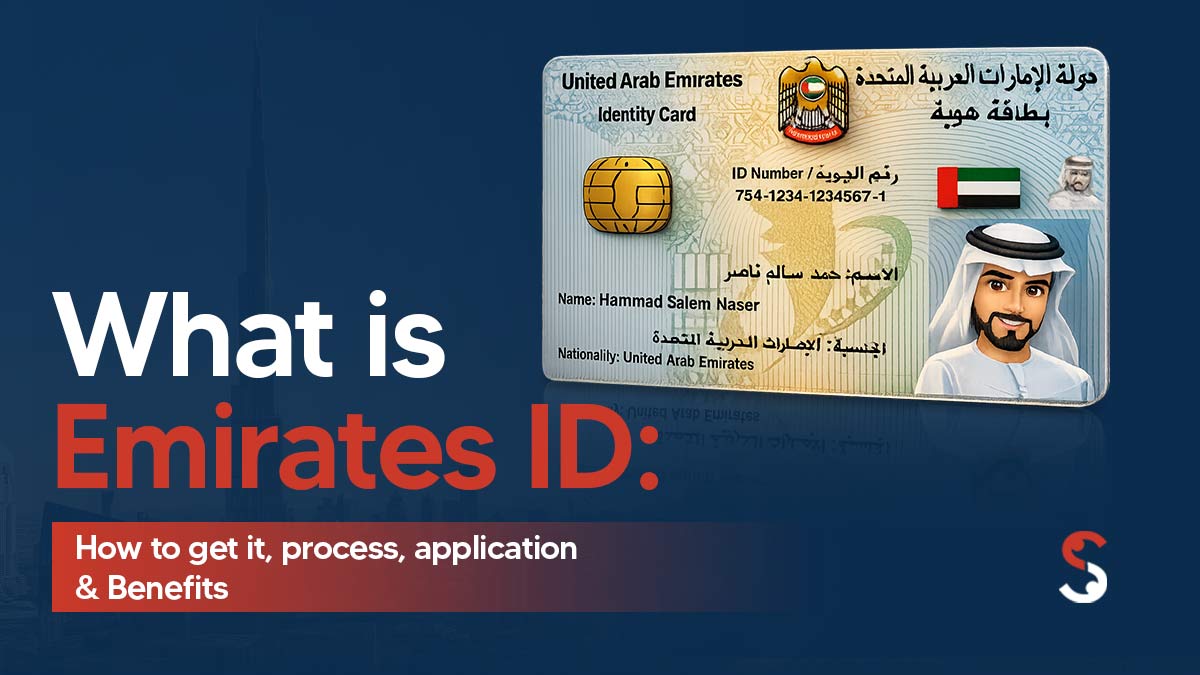
If you’re living, working, or planning to settle in the UAE, the Emirates ID is one document you simply can’t do without. It’s more than just an identification card; it’s your official proof of identity and residency in the country. Issued by the UAE government, the Emirates ID is required for everyday essentials such as opening a bank account, accessing healthcare, signing a rental agreement, and even using many government and private services.
Whether you’re a UAE national, an expat employee, an investor, or a dependent, understanding what the Emirates ID is and how it works can make life in the UAE much smoother.
In this guide, we’ll break down everything you need to know about the Emirates ID, including how to get it, the application process, and the key benefits it offers, clearly, simply, and without the jargon.
What is an Emirates ID?
Emirates ID is the official identity card issued by the UAE government to citizens, residents, and expatriates. It serves as your primary proof of identity and includes key details such as your name, photo, nationality, date of birth, and a unique lifelong ID number. Issued by the Federal Authority for Identity, Citizenship, Customs & Port Security (ICP), it is automatically linked to your residency visa once approved.
In daily life, the Emirates ID is essential. You need it to open a bank account, rent a home, get a SIM card, access healthcare, use government services, and even pass through airport e-gates. Without it, managing everyday tasks in the UAE becomes difficult. Some people may search for it as “emirated ID,” but it’s the same official document that proves your legal identity and residency in the UAE.
What are the Features of the Emirates ID?
The Emirates ID is the official national identity card issued by the UAE government’s Federal Authority for Identity, Citizenship, Customs and Port Security (ICP). It serves as a secure, smart identity document for every UAE citizen and resident and is legally required to live, work, and access most services in the country.
Here are the key features of the Emirates ID:
- Personal Identification Details
- Embedded Smart Chip
- Advanced Security Features
- Validity and Legal Use
- Biometric Authentication
- Smart Card Capabilities
- Integration With Digital Platforms
The Emirates ID is more than just a card with your name and photo; it’s a biometric, digitally integrated smart card that serves as the central identity credential for accessing essential services, verifying your identity securely, and participating in everyday life in the UAE.
What are the Benefits of Having an Emirates ID?
If you live in the UAE, your Emirates ID is something you’ll use almost every day, from opening a bank account to visiting a hospital or signing important documents. Below are the benefits of having an Emirates ID:
Official proof of identity in the UAE
Your Emirates ID is the most important ID you’ll carry in the UAE. It’s accepted everywhere, in government offices, banks, employers, and even hotels.
Easy access to government services
From visa-related services to healthcare and utilities, most government platforms require an Emirates ID (or Emirated ID, as many people search for it) to log in and complete applications smoothly.
Essential for banking and financial services
Opening a bank account, applying for loans, credit cards, or even using digital wallets is almost impossible without an Emirates ID.
Healthcare benefits and insurance access
Your Emirates ID is linked to your medical records and health insurance, enabling faster, hassle-free hospital visits and medical services.
Required for employment in the UAE
Employers legally require an Emirates ID for hiring, salary processing, and official documentation.
Smooth travel within the UAE
You can use your Emirates ID for domestic flights, hotel check-ins, and identity verification instead of carrying your passport everywhere.
Access to telecom services
Buying a SIM card, internet connection, or upgrading telecom services requires a valid Emirates ID.
Digital convenience
The Emirates ID is linked to smart services, e-gates, and UAE Pass, allowing secure digital access to multiple platforms.
Everyday convenience
From renting a home to signing contracts or even entering certain buildings, the Emirates ID makes daily life in the UAE much easier.
Who Can Apply for an Emirates ID?
Anyone legally living in the UAE must apply for an Emirates ID, including UAE nationals, residents with a valid visa, and GCC nationals. It serves as official proof of identity.
Additionally, it is required for essential tasks such as opening a bank account, obtaining a SIM card, signing a tenancy contract, and accessing government or healthcare services. The application process is mostly the same, with minor variations based on residency status.
For UAE Expats (Non-GCC Nationals)
If you’re an expat moving to the UAE for work, business, or family residence, your Emirates ID application is linked to your residency visa.
Once your entry permit is issued, you’ll need to apply for the ID through approved typing centres or online via the Federal Authority for Identity, Citizenship, Customs & Port Security. After submitting the application, you’ll be called for biometrics, which includes fingerprints, a photo, and a signature.
Once your residence visa is stamped, your Emirates ID is printed and delivered to your registered address or nearby post office.
For UAE Nationals
For UAE citizens, applying for an Emirates ID is quite straightforward. You can apply directly through official channels by submitting your family book (Khulasat Al Qaid) and other required documents.
Biometric details are collected during the application, and the ID is usually issued for a longer validity period. UAE nationals use this ID for everything, from healthcare and banking to voting and government services.
For GCC Nationals Living in the UAE
(Citizens of Saudi Arabia, Kuwait, Oman, Bahrain, and Qatar)
GCC nationals residing in the UAE can also apply for an Emirati ID, even though they don’t need a residence visa like other expats.
The process involves submitting a valid GCC passport or national ID along with proof of residence in the UAE (such as a work letter or tenancy contract). Biometric data is required, and once approved, the Emirates ID is issued for the approved duration of stay.
How to Apply for an Emirates ID(Offline)?
Applying for an Emirates ID offline is a straightforward process and is commonly used by first-time residents, employees, and dependents.
Step 1: Visit an Approved Typing Centre
Go to an authorised Emirates ID typing centre or an Amer service centre across the UAE. These centres are approved by the Federal Authority for Identity, Citizenship, Customs, and Port Security (ICP).
Step 2: Submit Required Documents
Provide the necessary documents, which usually include:
- Passport (original + copy)
- UAE residence visa (or entry permit for new residents)
- Passport-size photograph (if required)
- Previous Emirates ID (for renewal or replacement)
Step 3: Fill Out the Emirates ID Application Form
The typing centre will complete the Emirates ID application form on your behalf and submit it electronically to the ICP.
Step 4: Pay the Emirates ID Fees
Pay the applicable Emirates ID fees based on your visa validity (1, 2, or 3 years).
Step 5: Biometric Data Collection
If you are applying for an Emirates ID for the first time, you will be directed to an ICP service centre for biometrics, including:
- Fingerprints
- Photograph
- Digital signature
Step 6: Receive SMS Notifications
After submission, you will receive SMS updates about the status of your Emirates ID application.
Step 7: Collect Your Emirates ID
Once issued, your Emirates ID will be delivered to a designated post office. You’ll receive an SMS with collection details.
How to Apply for an Emirates ID(Online)?
The online Emirates ID application is convenient and ideal for renewals, replacements, or applicants who prefer digital services.
Step 1: Access the Official ICP Platform
Visit the official website or mobile application of the Federal Authority for Identity, Citizenship, Customs and Port Security (ICP).
Step 2: Log In or Create an Account
Sign in using your UAE Pass or create an ICP account to begin your Emirates ID application online.
Step 3: Select the Emirates ID Service
Choose the relevant Emirates ID service:
- New Emirates ID application
- Emirates ID renewal
- Emirates ID replacement (lost or damaged)
Step 4: Complete the Online Emirates ID Application Form
Enter accurate personal details such as:
- Full name
- Passport information
- Visa details
- Contact information
Step 5: Upload Required Documents
Upload clear digital copies of:
- Passport
- UAE visa or entry permit
- Recent photograph (if requested)
Step 6: Pay the Emirates ID Fees Online
Complete the payment securely through the online portal using a debit or credit card.
Step 7: Biometrics Appointment (If required)
First-time applicants or those updating biometric data will receive an appointment notification for biometric capture at an ICP service centre.
Step 8: Track Emirates ID Application Status
You can track your Emirates ID status online through the ICP portal or via SMS updates.
Step 9: Receive Your Emirates ID
Once approved, your Emirates ID will be dispatched to the selected post office for collection.
Whether you choose the offline or online method, applying for an Emirates ID is mandatory for all UAE residents and is essential for visas, banking, healthcare, telecom services, and government transactions.
Emirates ID: Your Key to Living in the UAE
In the UAE, the Emirates ID is not just another document; it’s the foundation of your everyday life. From the moment you arrive, it becomes your key to banking, healthcare, employment, housing, telecom services, and seamless access to government platforms. Whether you’re a first-time expat, an investor, a GCC national, or a UAE citizen, having a valid Emirates ID ensures you can live, work, and operate smoothly without unnecessary delays or complications.
Understanding how the Emirates ID works, its benefits, and the application process helps you stay compliant and stress-free in the UAE. And while the process is straightforward, having the right guidance can save you time, effort, and confusion, especially if you’re applying alongside a visa or business setup.
If you need expert assistance with your Emirates ID application, visa processes, or overall UAE compliance, Shuraa UK is here to help. You can drop a mail at info.london@shuraa.com or call us on +44 7538 205604, and our team will guide you every step of the way with clarity and confidence.
FAQs
Q1. How long is an Emirates ID valid?
The validity of an Emirates ID usually matches the duration of your visa. For residents, it is generally valid for 2 or 3 years, while UAE nationals receive IDs valid for 5 or 10 years.
Q2. What documents are required to apply for an Emirates ID?
To apply for an Emirates ID, you typically need:
- Passport (original and copy)
- UAE residence visa or entry permit
- Passport-size photograph
- Completed the Emirates ID application form
Q3. How long does it take to receive an Emirates ID?
The standard processing time is 7–10 working days from the date of biometric submission. In urgent cases, express services may issue the Emirates ID within 24 hours, subject to availability and approval.
Q4. Can I track the status of my Emirates ID application?
Yes, you can track your Emirates ID application online using your application number through the official ICP tracking system.
Q5. What should I do if my Emirates ID is lost, stolen, or damaged?
If your Emirates ID is lost, stolen, or damaged, you must:
- Report the issue immediately
- Apply for a replacement Emirates ID
- Pay the applicable replacement fee
Q6. How can I replace a lost or damaged Emirates ID?
You can apply for a replacement Emirates ID through an approved typing centre or online. A replacement card is usually issued within 5–7 working days.
Q7. When can I renew my Emirates ID?
You can renew your Emirates ID up to 30 days before expiry once your residence visa is renewed.
Q8. How early can an Emirates ID be renewed?
An Emirates ID can be renewed as soon as your new visa is issued, even if the existing ID has not yet expired.
Q9. What is the process of renewing an Emirates ID?
To renew your Emirates ID:
- Renew your UAE residence visa
- Submit a renewal application
- Complete biometric verification (if required)
- Receive the updated Emirates ID
Q10. How often do I need to renew my Emirates ID?
Emirates ID renewal is required every time your residence visa is renewed, usually every 2 or 3 years.
Q11. How can I cancel an Emirates ID?
An Emirates ID is automatically cancelled when your residence visa is cancelled. You do not need to cancel it separately.
Q12. What happens to my Emirates ID after visa cancellation?
Once your visa is cancelled, the Emirates ID becomes invalid and cannot be used for official purposes.
Q13. What should I do if I need to update my Emirates ID details?
If there are changes to your personal details (name, nationality, marital status, etc.), you must apply for an Emirates ID data update through authorised channels.
Q14. Can an employer legally keep an employee’s Emirates ID?
No, companies are not allowed to withhold an employee’s Emirates ID. The card is personal identification and must remain with the cardholder at all times.