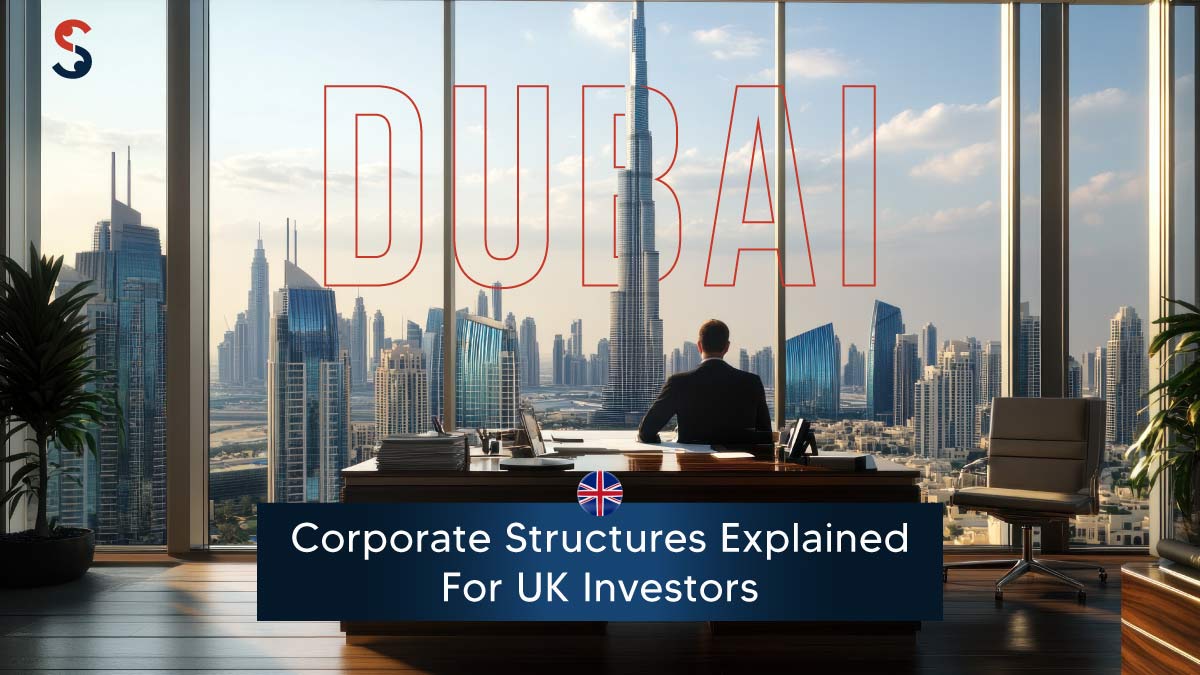
Every founder remembers the day they incorporated their first company. But few founders anticipate that one day, they may outgrow the very jurisdiction in which they started. For many UK entrepreneurs in 2026, that moment has arrived.
UK corporation tax has climbed to 25%. Dividend taxation is tightening. Post-Brexit market fluidity is shrinking. And for growth-focused founders, the question is no longer “How do I scale?”, but it’s “Where should I scale from?”
That question is increasingly leading them to Dubai. Yet relocating or expanding isn’t about booking a flight. It’s about choosing the right UAE company structure. One that protects profits, unlocks global markets, and positions your business for the next decade.
In this guide, we break down Dubai Corporate Structures in a way that makes sense specifically for UK founders who are expanding, restructuring, or building something new from the ground up.
Why UK Founders Are Looking at the UAE in 2026
The economic ties between the UK and the UAE are stronger today than at any point in history. Bilateral trade between the two countries surpassed £25 billion annually. This marks the UK as one of the UAE’s most significant trading partners. Capital, talent, and opportunity are already flowing between London and Dubai, and founders are following that momentum.
But trade links are only part of the story. Tax architecture is the real catalyst. As of 2026, a profitable UK company can face corporation tax of up to 25%. In contrast, the UAE applies a 9% corporate tax on taxable profits above AED 375,000, with potential 0% corporate tax for qualifying Free Zone entities.
For a scaling business, that structural difference directly impacts retained earnings, investor appeal, and long-term valuation. And that is precisely why Dubai corporate structures have moved from “tax curiosity” to strategic priority for UK founders.
But here’s the crucial point: Choosing Dubai is not enough. Choosing the right UAE company structure is what determines your long-term success.
Understanding Dubai Corporate Structures & Jurisdiction
When UK founders begin researching Dubai Corporate Structures, they’re often looking for a straightforward answer: set up a company and start trading. But it’s not that simple, and that’s a good thing!
The UAE has built a strategic corporate ecosystem, each governed by distinct regulatory frameworks. These structures are designed to support specific objectives: local market expansion, international trade, holding intellectual property, asset protection, or regional headquarters.
To make this clearer, let’s break down the main UAE company structures and what they mean for a UK entrepreneur.
1. Mainland LLC (Limited Liability Company)
A Mainland company is registered under the UAE’s federal commercial laws and allows you to trade freely across the UAE market.
Best for UK founders who:
- Want to operate physically in Dubai
- Plan to open retail outlets, restaurants, or service firms
- Want unrestricted access to the local UAE market
- Intend to bid for government contracts
Since new reforms were introduced under the UAE Commercial Companies Law, many activities now allow 100% foreign ownership.
Why Mainland Appeals to UK Entrepreneurs:
- No restrictions on UAE-wide trade
- Unlimited visa quotas (subject to office space)
- Eligible for government tenders
- Strong local market credibility
For founders relocating operations entirely from the UK, this structure often mirrors the flexibility of a UK Ltd, but within a more tax-efficient environment.
2. Free Zone Company
Free Zones are designated economic areas designed to attract foreign investment. There are over 40 Free Zones in the UAE, and each caters to different sectors.
Popular Free Zones include the International Free Zone Authority (IFZA), Ras Al Khaimah Economic Zone (RAKEZ), Dubai World Trade Centre (DWTC Free Zone), Ajman Free Zone Authority, and Dubai Multi Commodities Centre (DMCC). Each of these zones offer distinct advantages depending on the nature of your business.
Free Zone companies are particularly well-suited for:
- E-commerce brands selling globally
- SaaS and tech startups
- Consultants and advisory firms
- Intellectual property holding companies
- Digital and remote-first businesses
For financial and professional services, many UK founders consider the Dubai International Financial Centre (DIFC), which operates under an English common law framework, something that feels familiar to UK businesses.
Why Free Zones Are Popular Among UK Founders:
- 100% foreign ownership
- 0% corporate tax on qualifying income
- Simplified setup
- Strong international positioning
- Sector-specific ecosystems (media, tech, finance, logistics)
If your revenue is primarily international, and you don’t require direct trading access within the UAE mainland, a Free Zone structure is often the most efficient and scalable UAE company structure.
3. Offshore Company
Offshore companies are designed for international operations, and not for conducting business inside the UAE market.
They are commonly used for:
- Asset protection
- International trading
- Holding investments
- Owning real estate (in specific zones)
While offshore structures offer privacy and cost efficiency, they do not grant residency visas or local office rights. For UK founders focused purely on international structuring, this can be useful, but it’s not suitable for operational relocation.
Mainland vs Free Zone: What Should a UK Founder Choose?
The right Dubai corporate structure depends on how and where you generate revenue, and not just where you plan to live.
Choose Mainland If:
- You’re relocating fully to Dubai
- You need unrestricted UAE trade
- You plan to build a physical team locally
- You want long-term operational substance
Choose Free Zone If:
- You operate internationally
- Your clients are outside the UAE
- You want tax efficiency with lower setup costs
- You’re creating a regional HQ
Choose DIFC If:
- You are in fintech, wealth management, or regulated finance
- You want the English common law jurisdiction
- You want UK investors to feel structurally comfortable
UAE Legal Structures UK Founders Should Know
While Mainland LLCs and Free Zone companies are the most common structures for UK entrepreneurs, they are not the only options available. Depending on your business model, regulatory requirements, and expansion plans, the following legal structures may also be relevant.
1. Sole Proprietorship
A Sole Proprietorship is a business owned and operated by a single individual. In the UAE, this structure is typically used for professional services such as consultancy, design, marketing, or technical services.
For UK founders, this structure may be suitable if:
- You are offering professional services under your own name
- You do not require external shareholders
- You want a simplified legal structure
It is important to note that liability can be unlimited in certain cases, meaning the owner may be personally responsible for business obligations. As such, this structure is generally suited for low-risk service activities rather than scalable ventures.
2. Civil Company
A Civil Company is designed specifically for professional partnerships. It allows two or more professionals (such as consultants, lawyers, engineers, or doctors) to form a business together.
This structure may appeal to UK founders who:
- Are forming a professional practice with partners
- Operate in regulated advisory sectors
- Want shared ownership without forming a commercial LLC
Civil Companies are common in consultancy and specialist service industries and are governed by professional licensing requirements.
3. Branch of a Foreign Company
A Branch allows a UK company to establish a presence in the UAE without creating a separate legal entity. The branch remains fully owned by the parent company and operates under the same name.
This option may be appropriate if:
- You want to expand your existing UK company into the UAE
- You do not want to create a new shareholder structure
- You prefer consolidated control from the UK parent
However, the branch is not legally separate from the parent company, meaning liabilities can flow back to the UK entity. It is often used by established businesses entering the UAE market strategically rather than by early-stage founders.
4. Public Joint Stock Company (PJSC)
A Public Joint Stock Company (PJSC) is designed for large-scale enterprises that intend to raise capital from the public through a stock exchange listing.
This structure is generally relevant for:
- Large corporations
- Businesses planning an IPO
- Companies that require significant capital raising
PJSCs are heavily regulated and require substantial capital, governance structures, and public disclosure standards. For most UK founders expanding into Dubai, this is not a typical starting structure but may become relevant at a later stage of growth.
How Dubai Corporate Structures Interact with UK Tax
This is where many founders make mistakes. Setting up a UAE company does not automatically eliminate UK tax exposure.
Key considerations include:
- UK tax residency rules
- Central management and control tests
- Dividend taxation upon remittance
- Controlled foreign company (CFC) rules
- Real business presence in the UAE
The UK–UAE Double Taxation Agreement ensures you are not taxed twice. This is why the corporate structure should not be transactional. It must be advisory led.
Dubai’s 9% Corporate Tax: What It Really Means
The UAE introduced a federal corporate tax of 9% on profits exceeding AED 375,000. However, many Free Zone companies may qualify for 0% on qualifying income. Also, there is no personal income tax, no capital gains tax for individuals, and no dividend tax at the UAE level.
Compared to the UK’s 25% corporate tax, the difference is substantial. For growth-stage companies, the retained profit advantage can significantly accelerate scaling.
Real Strategic Structures UK Founders Are Actually Using
Behind the headlines about relocation and tax efficiency lies a more sophisticated reality: most UK founders are not simply “moving” their business. Rather, they are restructuring it.
Some retain a UK parent company while establishing a UAE subsidiary to manage Middle East operations. Others create a UAE holding company that owns international subsidiaries to improve capital flow and investor positioning.
Service-based founders often keep their UK Ltd active but relocate personally to Dubai. This helps them optimise profit extraction within the UAE’s tax framework. For fintech and SaaS businesses built around intellectual property, structuring through the DIFC can provide legal certainty while safeguarding valuable IP assets.
Each structure serves a specific purpose. There is no one-size-fits-all UAE company structure. The right UAE company structure depends on your revenue model, expansion plans, tax residency status, and long-term growth strategy.
Why Dubai and Why Now?
The UAE offers a politically stable environment with a government that consistently prioritizes pro-business reforms. Its infrastructure ranks among the most advanced globally. Positioned strategically between Europe, Asia, and Africa, Dubai operates in a time zone that allows founders to speak to London in the morning and Singapore by late afternoon.
More importantly, Dubai has matured into a serious global business hub. It attracts multinational corporations, venture capital, family offices, and high-growth startups alike. Regulatory frameworks continue to evolve in favor of foreign investment and innovation.
This is why the conversation has shifted. Dubai is no longer viewed as a tax-friendly alternative. It is increasingly recognized as a global platform for scaling ambitious companies.
Why Choose Shuraa UK for Your Business Expansion?
Many firms will sell you “company formation in Dubai.” But only a few will guide you through tax positioning, cross-border compliance, banking structuring, group architecture, and long-term scaling strategy.
This is where experience becomes critical. For over 26 years, Shuraa UK has helped 100,000+ entrepreneurs’ structure and establish businesses across Mainland, Free Zone, and Offshore jurisdictions in the UAE. Shuraa UK delivers more than incorporation support and helps you build trusted relationships across government departments.
Ready to explore the right Dubai corporate structure for your business?
Connect with Shuraa’s advisors today and take the first step toward building your UAE expansion strategy with clarity and confidence.
Remember: Dubai offers a platform, but the right structure determines your outcome.