
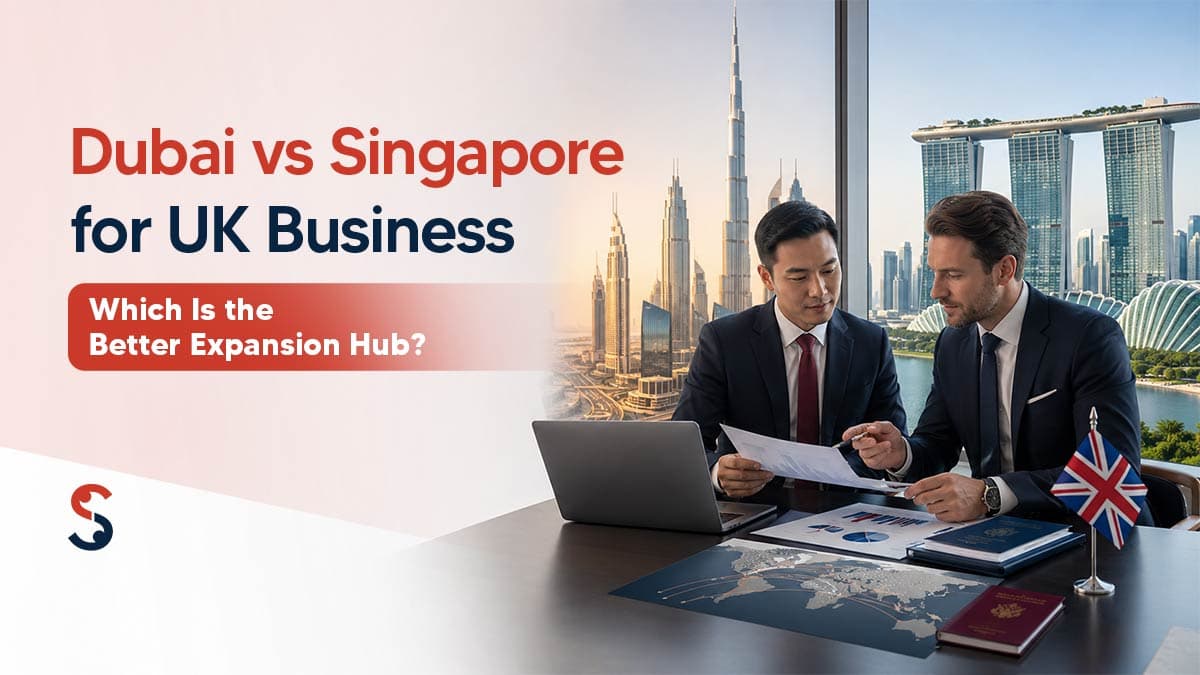
Imagine two entrepreneurs launching the exact same business. One sets up his business in Dubai, while the other chooses Singapore. Five years later, both companies are successful, yet they have taken completely different paths to get there. The Dubai-based founder benefited from low taxes, flexible visa options, and access to the Middle East’s rapidly growing markets. The Singapore-based founder leveraged world-class banking, investor confidence, and a strong presence across Asia-Pacific.
Neither founder made the wrong choice. They simply chose the jurisdiction that aligned with their business goals. That is exactly why the Dubai vs Singapore debate continues in 2026.
Both destinations consistently rank among the world’s most attractive business hubs. Both attract entrepreneurs, startups, investors, consultants, and multinational companies. Yet their strengths, costs, regulations, and growth opportunities differ significantly.
If you’re planning to start a company, relocate your business, or expand internationally, this guide will help you understand which destination may be the better fit for your long-term ambitions.
Dubai and Singapore in 2026: Why Are Entrepreneurs Comparing Them?
Despite being located thousands of miles apart, Dubai and Singapore share several similarities. Both transformed themselves from relatively small economies into globally recognised business hubs.
Both offer:
- Strategic geographic positioning
- Strong infrastructure
- International talent pools
- Stable economies
- Efficient company formation processes
- Business-friendly regulatory environments
However, their approach to attracting businesses is very different. Singapore built its reputation on governance, financial credibility, and access to Asia-Pacific markets. Dubai built its reputation on entrepreneurship, low taxation, international connectivity, and ease of doing business.
As a result, founders often find themselves choosing between two highly attractive but fundamentally different ecosystems.
Dubai vs Singapore: Key Differences
| Factor | Dubai (UAE) | Singapore |
| Personal Income Tax | 0% | Progressive tax rates |
| Corporate Tax | 0% up to AED 375,000 taxable income, 9% above | 17% headline rate with exemptions |
| Foreign Ownership | 100% in most sectors | 100% ownership possible |
| Local Director Requirement | No | Yes |
| Residency Through Business | Straightforward options available | More restrictive |
| Setup Speed | Often within days | Fast but more structured |
| Market Access | Middle East, Africa, Europe, Asia | ASEAN and Asia-Pacific |
| Business Structure Options | Mainland, Free Zone, Offshore | Primarily Pte Ltd |
| Hiring Flexibility | High | More regulated |
| Lifestyle | International, dynamic, tax-efficient | Efficient, structured, family-focused |
At first glance, both destinations appear competitive. However, the practical experience of operating a business can be very different.
Dubai vs Singapore: The Real Tax Comparison
Tax is usually the first factor entrepreneurs examine, and understandably so. The UAE remains one of the most tax-efficient jurisdictions globally.
In UAE, Business owners benefit from:
- 0% personal income tax
- 0% corporate tax on taxable profits up to AED 375,000
- 9% corporate tax above the threshold
- Potential advantages for qualifying free zone businesses
Singapore, meanwhile, applies a headline corporate tax rate of 17%. Although various startup and partial tax exemption schemes can reduce the effective burden for eligible businesses.
However, focusing solely on tax percentages can be misleading. The real question is: How much of your profits can you actually retain and reinvest into growth?
For many entrepreneurs, particularly consultants, agencies, e-commerce businesses, international trading firms, and service providers, the UAE’s combination of low corporate taxation and zero personal income tax create a compelling advantage.
Tax efficiency should always be evaluated alongside business goals, operational requirements, and future expansion plans. Many founders work with UAE business setup specialists to determine the most suitable structure before making a final decision.
Company Formation in Dubai vs Singapore: Which Is Easier?
For many international founders, the speed of their company setup matters a lot. Hence, the ability to establish a company quickly, obtain residency, open a bank account, and begin trading can significantly influence their decision.
Setting Up a Business in Dubai
The UAE has spent years streamlining the company formation process. UAE entrepreneurs can choose between Mainland companies, Free Zone companies, and Offshore structures, according to their business requirements.
Depending on the chosen jurisdiction and activity, founders can often:
- Own 100% of their company
- Obtain residency visas
- Sponsor family members
- Access local and international markets
- Establish operations within a matter of days
This flexibility is one of Dubai’s biggest advantages. Rather than forcing every business into a single framework, the UAE provides multiple pathways for entrepreneurs according to their business goals.
Setting Up a Business in Singapore
Singapore’s setup process is equally efficient but typically involves more structure.
Foreign entrepreneurs generally require:
- A locally resident director
- A registered local address
- Ongoing compliance obligations
- Annual filings and corporate governance requirements
While these requirements create additional administrative responsibilities, they also contribute to Singapore’s reputation for transparency and governance.
Key Insight –
Dubai optimises for flexibility, while Singapore optimises for structure. Neither approach is inherently better as the right choice depends on your business objectives.
For UK entrepreneurs exploring UAE company formation, choosing the right structure from the beginning can save significant time, costs, and compliance challenges later. This is where expert guidance can make the setup process far more straightforward.
Dubai vs Singapore Market Access: Which Region Can You Reach?
Entrepreneurs generally consider tax as the sole factor while choosing their business jurisdiction. Instead, their main focus should be on where their future customers will be.
Dubai’s Strategic Advantage
Dubai sits at the crossroads of three continents. From a single location, businesses can effectively serve GCC markets, Saudi Arabia, UAE, Africa, Europe, and South Asia. For UK entrepreneurs, Dubai also offers a relatively convenient time zone and flight connectivity compared to many Asia-Pacific destinations.
Singapore’s Strategic Advantage
Singapore serves as an exceptional gateway to ASEAN countries, Indonesia, Malaysia, Vietnam, Thailand, China, Japan, and Australia. Businesses focused on Asia-Pacific expansion often find Singapore highly attractive.
Many successful international businesses eventually establish a presence in both locations because each serves a different regional purpose.
If your business plans include expansion into the Middle East, Africa, or South Asia, obtaining local market insights and setup advice early can help you enter these regions more effectively and avoid unnecessary delays.
Business Banking and Compliance: Dubai vs Singapore
Singapore is often viewed as one of the world’s most respected financial centres. Its banking ecosystem enjoys a strong reputation among investors, multinational corporations, and global institutions. This credibility is one of Singapore’s greatest strengths.
However, entrepreneurs should also understand that strong compliance standards often mean more documentation, more scrutiny, and more administrative requirements.
Dubai’s banking sector has also matured significantly over the last decade. While compliance expectations have increased, the UAE continues to balance international regulatory standards with a business-friendly approach.
Hiring Talent in Dubai vs Singapore: What Businesses Need to Know?
A business is only as strong as its people. Fortunately, both Dubai and Singapore attract international talent.
Why Businesses Like Hiring in Dubai
- A highly international workforce
- Access to talent from Europe, Asia, Africa, and the Middle East
- Flexible visa frameworks
- Competitive employment costs in many sectors
Singapore’s Strength
Singapore offers one of the most educated and skilled workforces globally.
It is particularly strong in:
- Technology
- Financial services
- Research
- Advanced industries
In simple terms –
- Dubai offers broader hiring flexibility.
- Singapore offers deeper access to specialised expertise.
Lifestyle: Dubai vs Singapore
One of the most important factors that is not included in the business strategy but heavily impacts entrepreneurs’ decision is the kind of lifestyle the city they are planning to start their business offers.
Dubai Lifestyle
Many founders are attracted by:
- Tax-free personal income
- Luxury lifestyle
- Spacious housing options
- Strong international community
- Year-round connectivity
- Modern infrastructure
Dubai often appeals to entrepreneurs focused on wealth creation and international mobility.
Singapore Lifestyle
Singapore attracts founders who value:
- Exceptional public transport
- Green urban spaces
- Family-friendly environment
- World-class healthcare
- Educational excellence
- Efficient daily living
Singapore often appeals to entrepreneurs seeking long-term stability and quality of life.
Common Mistakes Entrepreneurs Make When Comparing Dubai and Singapore
Many entrepreneurs focus on the obvious benefits while overlooking factors that can have a major impact on long-term business growth.
Banking requirements, residency options, market access, hiring flexibility, compliance obligations, and expansion plans all play a role in determining whether a jurisdiction is the right fit.
Understanding these challenges before making a decision can help avoid costly mistakes and ensure your business is built on the right foundation from day one.
1. Looking Only at Tax Rates
Many founders compare jurisdictions based solely on headline corporate tax rates. Market access, banking convenience, operational costs, visa options, and regulatory requirements can have an equally significant impact on business performance. A slightly higher tax rate may be worthwhile if it supports faster growth and easier expansion.
2. Ignoring Long-Term Expansion Plans
Entrepreneurs should think beyond the first year and consider future hiring plans, international operations, fundraising requirements, and expansion into new markets. Choosing the wrong jurisdiction initially can lead to costly restructuring and administrative challenges later.
3. Underestimating Compliance Requirements
Singapore generally requires more structured compliance, annual filings, and local director arrangements, while UAE businesses must maintain licence renewals, accounting records, and corporate tax compliance where applicable. Understanding these requirements early helps avoid penalties and operational disruptions.
4. Choosing Based on Reputation Alone
While reputation matters, the best choice depends on your specific business model, customer base, and growth strategy. What works for a fintech startup targeting Asia may not be ideal for an e-commerce business serving the Middle East and Europe.
5. Overlooking Banking and Operational Practicalities
Opening a corporate bank account, processing international payments, and managing multiple currencies can significantly affect daily operations. Some founders focus heavily on incorporation costs while overlooking banking accessibility, transaction fees, and payment infrastructure.
Dubai vs Singapore – Which Is Better?
There is no such answer as Dubai and Singapore are solving different problems for entrepreneurs.
If your priority is lower taxes, flexible residency options, rapid setup, and access to Middle Eastern markets, Dubai may offer the stronger proposition.
If your focus is institutional credibility, investor access, advanced banking, and expansion throughout Asia-Pacific, Singapore may be the better choice.
The most successful entrepreneurs do not choose their business jurisdiction because it is popular. They choose a jurisdiction because it supports the business they want to build.
Why Are UK Entrepreneurs Increasingly Choosing Dubai?
Over the last few years, an increasing number of UK entrepreneurs, consultants, e-commerce businesses, and investors have chosen Dubai as their preferred international expansion destination.
The combination of low taxation, straightforward company formation, residency opportunities, strategic global connectivity, and access to emerging markets makes the UAE particularly attractive for businesses looking beyond the UK.
While Singapore remains a strong option for Asia-focused expansion, Dubai’s ability to connect Europe, the Middle East, Africa, and South Asia from a single location continues to strengthen its position as one of the world’s leading business hubs.
How Shuraa UK Can Help?
Choosing between Dubai and Singapore is a strategic business decision that impacts your growth, compliance obligations, banking relationships, and future expansion plans.
Whether you are relocating from the UK, launching a new venture, or expanding internationally, the experts at Shuraa UK can help you evaluate the most suitable structure based on your business goals.
From UAE company formation and residency solutions to banking assistance and compliance support, Shuraa UK provides end-to-end guidance to simplify your expansion journey.
Get in touch with Shuraa UK experts today!
Frequently Asked Questions
1. Is Dubai better than Singapore for company formation?
Generally, yes. Dubai offers no personal income tax and a lower corporate tax environment. However, Singapore provides various tax incentives that may reduce the effective tax burden for eligible startups.
2. Why do many entrepreneurs choose Dubai over Singapore?
Many founders choose Dubai because of its combination of low taxation, 100% foreign ownership options, business-friendly regulations, and relatively fast company formation processes.
3. Does Singapore require a local director?
Yes. Foreign-owned Singapore companies generally require at least one locally resident director. There is no such need in the UAE. Most business activities in the UAE now allow 100% foreign ownership, both in mainland and many free zone jurisdictions.
4. Which city is better for startups?
It depends on your target market and industry. Technology and venture-backed startups often prefer Singapore, while service businesses, consultants, and international trading companies frequently choose Dubai.
5. Is banking easier in Dubai or Singapore?
Singapore has a stronger global banking reputation, while Dubai offers a robust banking ecosystem with growing compliance requirements. The ease of account opening depends heavily on business activity and documentation.
6. Which location is better for UK entrepreneurs?
UK entrepreneurs targeting the Middle East, Africa, and international markets often find Dubai attractive. Those pursuing Asia-Pacific expansion may benefit more from Singapore.
7. Can I obtain residency through company formation?
Yes. Both jurisdictions offer pathways for entrepreneurs to live and operate their businesses. Although requirements differ significantly in both countries.